Decision Making Process in CARICOM
The Revised Treaty of Chaguaramas provides for decision-making by voting; nevertheless, decisions in the organs and bodies of the Community are arrived at through consensus.
The voting procedures outlined by the Revised Treaty are two types. Decisions at the Conference require unanimity. However, if up to 25 per cent of its membership choose to abstain, the result would still be deemed an affirmative one. One negative vote however, blocks unanimity, resulting in no decision.
In the other organs and bodies, a decision can be taken once three quarters of the members vote in the affirmative. The Revised Treaty provides opportunities for civil society to be brought into the decision-making through consultation.
Decision Making Process
Policy Initiation
Proposals may originate from a Member State or the CARICOM Secretariat. The Secretariat frequently provides technical drafting and policy analysis, while Member States introduce initiatives aligned with national or regional priorities.
Origin: Member State or CARICOM Secretariat, with technical drafting support from the Secretariat.
Technical Review
Proposals undergo detailed examination at the ministerial or specialised committee level. This stage ensures legal coherence, fiscal feasibility, and consistency with Community obligations, particularly under the CARICOM Single Market and Economy (CSME).
Scrutiny covers legal coherence, fiscal feasibility, and CSME compliance.
Consideration by the Relevant Council
Subject-specific ministerial councils deliberate and may adopt decisions within their delegated competence. The relevant council is determined by the subject matter of the proposal.
COTED:Trade & Economic Development
COFCOR: Foreign Relations
COHSOD: Human & Social Development
COFAP: Finance & Planning
CONSLE: Security
Escalation to the Community Council
Where matters are cross-sectoral or require broader coordination, they are referred to the Community Council of Ministers. This body ensures policy coherence and strategic alignment across portfolios.
Triggered by cross-sectoral matters requiring coordinated policy response.
Determination by the Conference of Heads of Government
Issues of strategic, constitutional, or treaty significance are submitted to the Conference of Heads of Government of CARICOM, the Community's supreme organ. Decisions are typically taken by consensus, reflecting the sovereign equality of Member States.
Decisions taken by consensus, reflecting the sovereign equality of all Member States.
National Implementation
Adopted decisions are implemented by Member States through domestic legislative or administrative measures. Unlike supranational systems, CARICOM decisions generally require incorporation into national law.
Intergovernmental model, decisions require domestic incorporation, not direct application.
Judicial Review
Where disputes arise concerning interpretation or application of the Treaty, the Caribbean Court of Justice (CCJ) exercises original jurisdiction, ensuring uniform interpretation and reinforcing legal certainty within the integration framework.
The CCJ holds original jurisdiction, the ultimate guardian of Treaty interpretation.
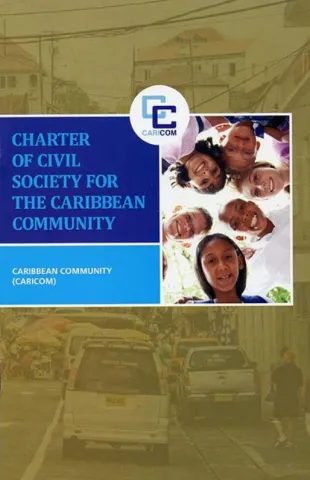
Charter of Civil Society
The Charter of Civil Society acts as a moral and normative framework for CARICOM, rather than a legally binding document. Adopted in 1997, it guides the decision-making process by outlining regional principles like human rights, good governance, and public consultation, encouraging member states and regional bodies to incorporate civil society perspectives into policy.While the Charter establishes a mandate for people-centered governance, its integration into CARICOM’s practical decision-making functions operates in specific ways:
Advisory and Consultative Role: The Charter provides the foundational basis for Civil Society Organisations (CSOs) to demand a seat at the table. It requires governments to facilitate consultation with labor unions, private sector bodies, and NGOs when developing major social and economic policies.
Institutional Engagement: CARICOM Organs, such as the Conference of Heads of Government and the Secretariat, use the Charter's principles to structure ongoing dialogue and information-sharing with groups like the Caribbean Policy Development Centre (CPDC) and the Caribbean Congress of Labour.